Use cases

From large-scale computational screening to autonomous laboratory experiments — a look at what researchers build with AiiDA.


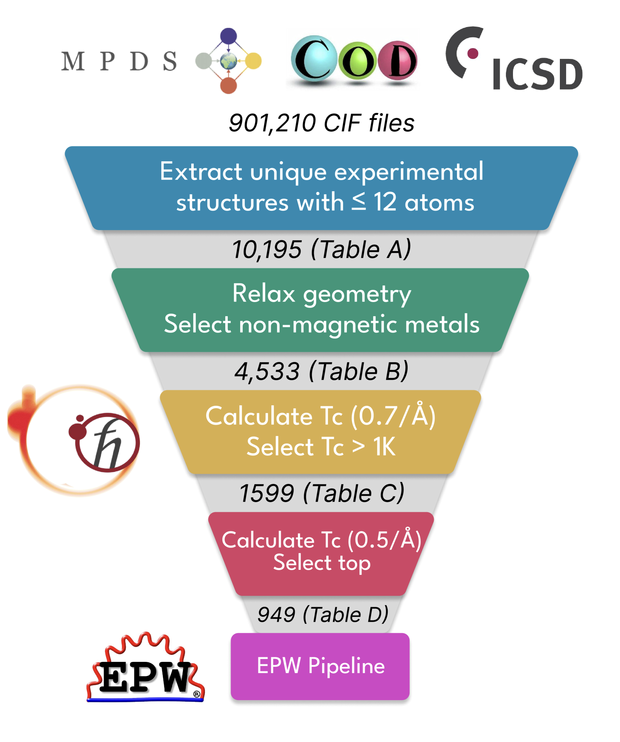
High-throughput screening funnel: roughly 900,000 known crystal structures are narrowed through successive AiiDA workflow stages down to a shortlist of candidate superconductors.
The high-throughput screening funnel, from the featured study (CC BY 4.0).

High-throughput materials science

Screening thousands of compounds for new superconductors

Featured study: M. Bercx, S. Poncé, Y. Zhang et al., “Charting the landscape of Bardeen–Cooper–Schrieffer superconductors in experimentally known compounds” , PRX Energy 4, 033012 (2025).

High-throughput studies push a single computational method across thousands of materials at once — far more calculations than any researcher could launch, babysit, and bookkeep by hand. AiiDA submits the jobs, retries the ones that fail, and records every input, code, and result in a queryable provenance graph, so a campaign of this size stays reproducible from the first structure to the last.

In one recent screening, researchers searched the Materials Cloud three-dimensional structure database (MC3D) of experimentally known inorganic compounds for conventional, phonon-mediated superconductors. AiiDA orchestrated the full pipeline — electronic-structure relaxations, phonon calculations, electron–phonon coupling, and critical-temperature estimates — across more than 4,500 candidate metals. The search recovered known superconductors and surfaced 24 previously unreported ones with predicted critical temperatures above 10 K.
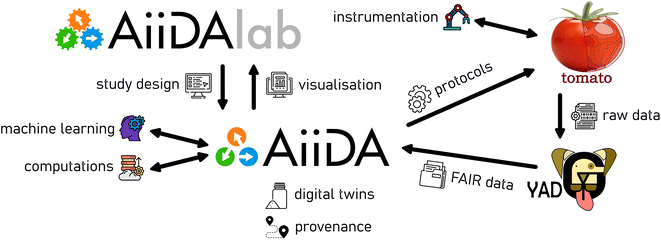

Data-flow schematic with AiiDA at the centre, connecting AiiDAlab, automated instrumentation, raw data, FAIR data archiving, machine learning, and computations.
Figure from the featured study (CC BY 3.0).

Driving experiments

Autonomous battery testing with the Aurora platform

Featured study: P. Kraus, E. Bainglass, F. F. Ramirez et al., “A bridge between trust and control: computational workflows meet automated battery cycling” , J. Mater. Chem. A 12, 10773–10783 (2024).

AiiDA is not limited to simulations: the same engine that manages computational jobs can also drive physical instruments. That makes it possible to plan, run, and track a laboratory experiment with exactly the reproducibility and provenance researchers expect from a calculation.

The Aurora platform pairs a robotic line that assembles and cycles coin-cell batteries with AiiDA. Each real-world experiment is submitted and monitored like a computational job, and AiiDA records complete provenance for every cell — linking protocols, raw measurements, and analysis into a single graph. Live monitoring lets the platform stop underperforming cells early, and legacy measurements are folded into the same digital record, bridging trust in the data with hands-off control of the lab.


Using AiiDA in your research? Tell us about it on Discourse .